Best Fishing Gear for Fishing in Stavanger, Norway

Fishing in Stavanger takes place in sheltered fjord environments, where success depends less on heavy equipment and more on control, balance, and understanding what is happening below the surface.

It is not about using the most powerful gear or the most complicated setup. It is about adapting to the conditions, maintaining contact with the bottom, and keeping things simple enough that the experience stays calm, focused, and enjoyable.
At the same time, the right equipment makes a clear and measurable difference.
Through many years of fishing in the Stavanger fjords, and from previously running my own fishing equipment store, I have developed a practical understanding of what actually works. Not just in terms of catching fish, but in creating a smoother, more engaging experience on the water.

Well-balanced, high-quality gear provides better sensitivity, more control, and a more comfortable experience — especially for those who are new to fjord fishing. It also removes many of the small frustrations that can quickly take away from the day.
The goal is not to use more gear, but to use the right gear — adapted to the depth, the conditions, and the people on board.
In this guide, I’ll walk you through the fishing gear I use in Stavanger and explain why this setup works so well in fjord conditions. While the focus is on local waters, the same principles apply to many fjord and coastal environments across Norway and similar locations worldwide.
What Fishing Gear Do You Need for Fjord Fishing in Stavanger?
The best fishing gear for fjord fishing in Stavanger is a light to medium spinning setup with a sensitive rod, thin braided line, and simple bait or jigs adapted to the depth. Most fishing takes place between 10–80 meters, where control and sensitivity matter far more than heavy equipment.
One of the most common questions I get from guests about Stavanger fishing is what kind of gear is actually needed for fjord fishing in Norway. The short answer is less than most people expect — but quality and the right setup make a clear difference.

In sheltered fjord environments like Stavanger, you don’t need heavy offshore equipment. Most fishing is done at moderate depths, often using relatively light and well-balanced setups.
In practice, I use a range of equipment depending on the conditions and what we are targeting — from ultralight setups in the 4–10 gram range for highly sensitive shallow fishing, to more powerful rods for deeper fjord conditions. However, most trips are done using light and sensitive rods rated around 30–80 grams, paired with smooth, high-quality spinning reels.
What matters more than raw power is balance. The gear needs to be sensitive enough to feel what is happening below, while still being strong enough to handle the fish you may encounter.
At the same time, depth plays an important role. The setup that works well at 20–50 meters is not the same as what you need at 100 meters or deeper. This is why I continuously adjust the setup depending on depth, drift, and conditions.
Why I Keep My Fishing Gear Setup Simple on Guided Trips
On my trips, I intentionally keep the setup simple. In practice, this usually means fishing with two rods at a time. The reason is not limitation, but control.

When too many lines are in the water, things quickly become more complicated than they need to be. Lines cross more easily, especially as the boat drifts or when fish change direction. This often leads to tangles, lost time, and unnecessary stress on board.
By keeping the number of rods low, it becomes much easier to stay in control of the situation. Each person has space to fish properly, and it is easier to stay aware of what is happening below the surface.
When there are four guests on board, I usually split it into two and two. While two are actively fishing, the others are still fully involved. They can follow the sonar, learn how we read the bottom and locate fish, and take part in the decisions we make along the way.
This creates a more engaging experience for everyone. You are not just waiting for your turn, but actively learning and understanding what is happening throughout the trip.

It also makes a clear difference for the guiding itself. Instead of spending time untangling lines or managing multiple setups, I can focus on helping you fish better — explaining technique, adjusting your setup, and guiding you through what is happening in real time. This creates a much more active and personal experience.
For most guests, this means less confusion and more learning. You get a clearer understanding of how the gear works, how the lure moves, and how fish react in the fjord.
The result is a calmer, more controlled, and more rewarding experience on the water.
The Fishing Gear I Use for Fishing in Stavanger (10–80 meters)
This is the setup I use on most trips. Fishing between 10 and 80 meters covers a large part of fjord fishing in Stavanger, especially around islands, shallow structures, and transition areas where fish are often most active.

At these depths, the goal is to keep the setup light, controlled, and easy to handle. This makes it easier to stay in contact with the lure, feel subtle changes along the bottom, and react quickly when a fish takes.
In practice, this is where most guests experience how Stavanger fishing actually works — not just dropping a line, but understanding movement, depth, and structure as it happens.
If you’re new to this type of fishing, you can get a broader understanding in my ultimate guide to fjord fishing in Stavanger, where I explain the fundamentals in more detail.
Rod and Reel Setup for Light Fjord Fishing
For most situations in this depth range, I use a setup that is light enough to be comfortable, yet strong enough to handle solid fish. In practice, I rotate between a few carefully selected combinations that are well suited for fjord conditions.

One of my most used setups is the Penn Battalion Solid Light Jig spinning rod, paired with a Penn Battle IV 3000 reel. This is a well-balanced and reliable combination that provides a smooth, controlled feel, while still having enough power to handle larger fish when needed.
For situations where I want even more direct control, I use a slightly more compact and responsive setup with the SG4 Fast Game BC (30–80g) paired with a Penn Squall Low Profile 300 reel. This combination gives a very direct connection to the lure and makes it easier to feel subtle movements, especially when fishing more actively.
Both setups are built around the same principle: balance. The goal is not to use heavy gear, but to use equipment that allows you to feel what is happening below the surface while still having enough strength when it matters. A well-matched rod and reel setup makes it easier to fish with precision, stay in control, and reduce fatigue over time.
Line Choice: Fireline vs Braid for Controlled Fishing
Line choice plays a bigger role than many people expect. For most of my setups, I use braided line in the range of 0.14–0.19 mm. This provides a strong balance between sensitivity, control, and durability across different depths and conditions.

A thinner line reduces drag in the water and makes it easier to stay in contact with the bottom, especially when the boat is drifting. This is essential in fjord fishing, where even small changes in depth or position can make a noticeable difference.
Sensitivity is just as important. A well-balanced braided line allows you to clearly feel the bottom, detect subtle changes in terrain, and recognize small bites that would otherwise go unnoticed.
At the same time, durability matters. When fishing close to structure or around the boat, the line needs to handle occasional contact without compromising performance. For that reason, I always use a short mono leader, typically around 1 meter, at the end of the braided line. This provides extra abrasion resistance when fishing close to the seabed and helps protect against sharp edges and rough terrain.
In many situations, I also use SpiderWire braided line with color changes every 10 meters, which makes it much easier to track depth in real time and adjust quickly as conditions change — especially when fishing along edges and transitions.
Lures, Weights and Rigs for Shallow Fjord Areas
In this depth range, flexibility is key. Most of the fishing is done using natural bait such as shrimp or mackerel. This is often the most effective approach and typically gives the most varied catch, as different species react to scent, movement, and how the bait is presented along the seabed.

When using bait, the goal is to keep it moving naturally while maintaining contact with the bottom. Small lifts, pauses, and controlled movement often make a noticeable difference, especially when fish are less active.
At the same time, I also use soft baits like jigs when conditions allow it. These can be very effective when fish are more active, and they make it easier to stay in direct contact with the lure. Soft baits also give a more active style of fishing, where you can adjust movement and depth continuously.
In calmer conditions, we can also fish with traditional metal lures, usually up to around 60 grams, sometimes combined with small teaser hooks above. This adds variation and can be a fun and effective way to fish, especially when fish are feeding slightly higher in the water column.
Weight selection plays an important role. The goal is always to use the lightest possible weight while still maintaining consistent contact with the bottom. This improves sensitivity and makes it easier to feel what is happening below, rather than simply dropping a heavy rig and waiting.
Conditions can change throughout the day, so I continuously adjust weight, bait, and presentation depending on depth, drift, and how active the fish are. Often, small changes are enough to turn a quiet drift into a more productive one.
The overall goal is to keep the setup simple, effective, and easy to use, while still allowing for small adjustments that make a real difference.
Why This Setup Works So Well for Most Guests
This setup works well for most guests because it reflects how Stavanger fishing is typically done — simple, controlled, and easy to understand.
You can feel the bottom, notice small changes, and stay actively involved throughout the fishing. Instead of just dropping a line and waiting, you begin to understand how the gear moves, how the seabed changes, and how fish respond in different situations.

For many guests, this is where the experience starts to change. Fishing becomes more engaging and easier to learn, especially if you have little or no previous experience.
It also creates a calmer and more controlled pace throughout the day. There is time to adjust, ask questions, and understand what is happening — rather than trying to keep up with a complicated setup.
This is an important part of how I run my trips. The goal is not just to catch fish, but to create an experience where you feel involved, confident, and able to understand what you are doing.
Seeing Fish in Real Time – Sonar and Live Fish Tracking on Board
One of the most useful tools on board is the sonar system, which allows us to see what is happening below the boat in real time.

Instead of guessing, we can clearly understand depth, identify structure, and spot fish activity as it happens. This makes it much easier to adjust both technique and position throughout the trip.
The sonar is also used actively to find the right fishing spots. Rather than stopping randomly, we look for structure, depth changes, and visible fish before we start fishing. This helps ensure that we are working in areas where fish are actually present, rather than just hoping for the best.
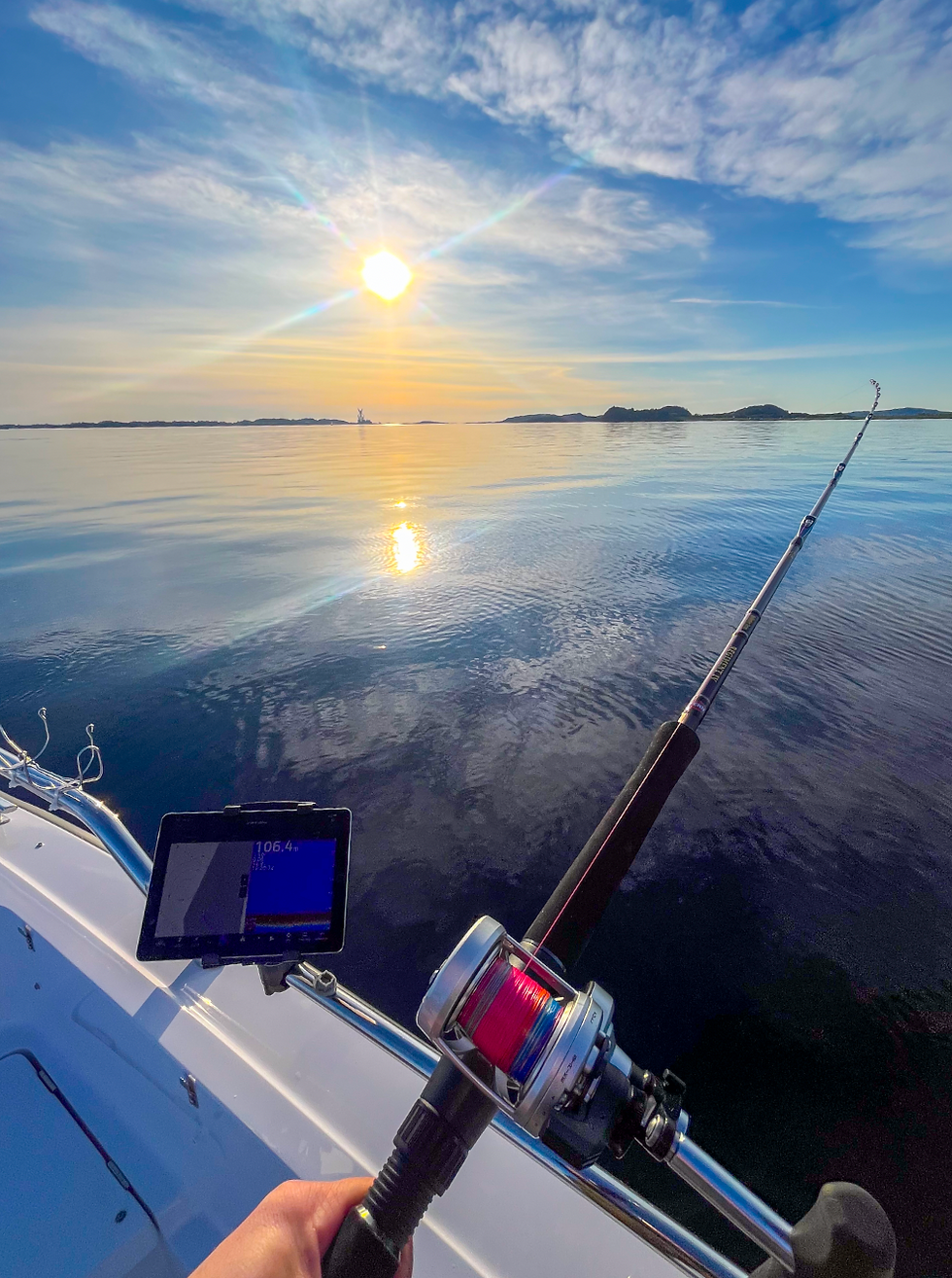
I also mirror the sonar display to an iPad, which is mounted right by the railing where you fish. This allows you to follow along while you are actively fishing, without having to step away or look elsewhere.

In rainy conditions, the iPad is usually placed inside the window, where it is still clearly visible from the fishing position. This means you can continue to follow what is happening below the surface even when the weather changes.
You can see the depth, understand how the seabed changes, and often spot fish at different levels in the water column. This creates a much clearer picture of what is happening below, and helps explain why we adjust how and where we fish.
This is a big part of what makes Stavanger fishing easier to understand, especially if you are new to fjord fishing. It becomes a calm, visual way of understanding what is happening beneath the surface, rather than simply waiting for a bite.
Fishing Gear for Medium Depths in Stavanger (80–200 meters)
When we move into deeper water, the fishing starts to change. In this depth range, fish are often holding closer to structure, and we begin to target different species such as cod and pollack, and in some cases deeper-water species like ling and tusk.

The conditions are usually more stable, but the increased depth requires a more precise and slightly heavier setup to stay in contact with what is happening below. This is typically where we fish along deeper edges, drop-offs, and transition areas where fish tend to gather.
At this stage, I mainly use two different setups depending on how we choose to fish: active jigging (pilking) and bait fishing. Each approach is adapted to different conditions and target species.
When I Switch to a More Powerful Setup
As depth increases, maintaining consistent contact with the bottom becomes more demanding. Wind, current, and drift all have a greater effect, and lighter setups are no longer sufficient.

For active jigging, I use shorter and stiffer jigging rods paired with a Penn Spinfisher VII 4500 spinning reel, spooled with 0.20 mm FireLine and a mono leader. This setup provides the strength needed to handle heavier lures while still maintaining control and responsiveness.
The lures used here are typically larger metal jigs, often in the 200–500 gram range, depending on depth and drift. These are usually combined with a simple teaser or hook above the jig.
This style of fishing is more active and is often used when targeting species like cod and large saithe, where movement and presentation play a key role.
Bait Fishing Setup for Deeper Fjord Areas
For bait fishing, I switch to a more traditional and controlled setup using a Penn Regiment IV Boat Rod (20–30 lb) paired with a Penn Warfare II Level Wind reel (20 lb), again spooled with 0.20 mm FireLine and a mono leader. This setup is designed for stability and control when fishing deeper with natural bait.
The typical rig used is a boom rig with a lead weight, trailing line, and one or more hooks. This allows the bait to stay close to the bottom while still moving naturally with the drift.
Bait fishing is often the most effective method when targeting species such as cod, ling, tusk, halibut, and various deep-water species, especially when fish are less active.
Adjusting Line, Weight and Technique
In this depth range, small adjustments become even more important. The goal is always to maintain consistent contact with the bottom without using more weight than necessary.
This requires continuous adjustment of:
weight (depending on depth and drift)
line angle
boat position
Sometimes, even a small reduction in weight or a slight change in drift angle can significantly improve how the bait or lure behaves.
Compared to shallower fishing, this type of fishing is less about constant movement and more about precision and control. Staying connected to the bottom and understanding how your setup behaves is what makes the difference.
Deep Water Fishing Gear in Stavanger (200–400 meters)
For deep water fishing, the setup is not completely different — it is an extension of the same principles used in medium depths.

If we are fishing around 200 meters, I often continue using the same bait fishing setup as in the 80–200 meter range. This works well as long as we are able to maintain consistent contact with the bottom. However, once we move deeper than this, the demands on the gear increase.
At greater depths, I switch to a heavier and more powerful setup using a Penn Regiment IV Boat Rod (30–50 lb) paired with reels such as the Penn Fathom or Penn Squall. These setups are better suited for handling increased weight, deeper drops, and larger fish.

We also use heavier sinkers and rigs, which require more strength and stability in both rod and reel. To maintain control at these depths, I increase the line diameter slightly, typically to 0.25 mm FireLine with a mono leader. This provides additional strength and durability while still allowing enough sensitivity to stay in contact with the bottom.
The goal is not simply to use heavier gear, but to maintain the same level of control and connection — even in much deeper water.
Deep water fishing is not the main focus of most trips. It is typically offered as a separate, more specialized experience, where the day is planned specifically around fishing at greater depths.
If you are interested in this type of fishing, you can read more about how it works in practice on my deep water fishing trips in Stavanger.
Choosing Between Deep Water Fishing and Fjord Fishing in Stavanger
Deep water fishing and fjord fishing are two different types of experiences, and on my trips they are usually chosen as a clear direction for the day rather than something we combine.
When we focus on deep water fishing, we target species such as ling and tusk. This involves fishing at greater depths with heavier setups and a more focused and patient approach. The reward is the possibility of larger fish and a very different experience compared to typical fjord fishing.

Fjord fishing in shallower areas offers a different type of day. It usually provides more variation, more frequent activity, and a wider range of species, all in a calmer and more flexible setting.
For this reason, most guests choose one direction — either a more focused deep water fishing experience, or a more varied fjord fishing trip.
If you would like a more detailed comparison, you can read my guide to Deep Water vs Shallow Water Fjord Fishing in Stavanger – What’s the Difference?
If you are unsure which option suits you best, I’m happy to help you choose based on your preferences and the type of experience you are looking for.
How My Fishing Gear Setup Improves the Guest Experience
The way the fishing gear is set up is not just about efficiency — it directly shapes the entire experience of fjord fishing in Stavanger.
By keeping the setup simple, balanced, and adapted to the conditions, it becomes much easier to stay focused on the actual fishing. You avoid crossed lines, constant adjustments, and many of the small frustrations that often come with more complex setups.

This creates more time for guidance. Instead of managing gear, I can focus on helping you fish better — explaining technique, adjusting your setup, and guiding you through what is happening below the surface in real time.
It also changes how you experience the fishing itself. With a well-balanced and sensitive setup, you can clearly feel the bottom, notice subtle changes in structure, and recognize when a fish interacts with the bait. This makes the fishing more engaging, more controlled, and much easier to understand.
At the same time, the pace of the trip becomes calmer and more structured. There is no rush and no pressure to keep up. You have time to adjust, learn, and stay present in what you are doing — which is a key part of how I run my guided fishing trips in Stavanger.
For many guests, especially those who are new to fishing, this makes a significant difference. Instead of feeling unsure or overwhelmed, you get a clear and relaxed introduction to fjord fishing in Norway, where learning and enjoyment come naturally.
Do You Need Your Own Fishing Gear in Stavanger?
No — everything you need is provided on board.

All fishing equipment is prepared and ready to use, including rods, reels, line, rigs, and all necessary safety gear. The setup is already adapted to the conditions and the type of fjord fishing in Stavanger, so you don’t need any previous experience to get started.
You also receive guidance throughout the trip, making it easy to understand how the gear works and how to fish effectively from the beginning.
You are of course welcome to bring your own gear if you prefer. However, most guests choose to use the equipment on board, as it is specifically selected for local conditions and designed to create a smooth and enjoyable experience.
This keeps the day simple and relaxed. You don’t have to think about setup, compatibility, or adjustments — everything is ready, so you can focus on the fishing and the experience itself.
Fishing Gear in Stavanger vs Offshore Fishing in Norway
There is a clear difference between fishing in Stavanger fjords and offshore fishing along the Norwegian coast.

Offshore fishing typically involves greater depths, heavier equipment, and more exposure to wind and open sea conditions. The focus is often on larger species and more demanding setups, where power and endurance play a bigger role.
Fjord fishing in Stavanger, on the other hand, takes place in more sheltered waters, often closer to land and with shorter travel distances. The underwater terrain is more varied, with islands, edges, and transition areas that create ideal conditions for lighter and more precise fishing.
This allows for the use of more sensitive and well-balanced gear, making it easier to stay in contact with the bottom, feel subtle changes, and actively follow what is happening below the surface.
For most guests, this creates a calmer, more personal, and more engaging experience. Instead of focusing on heavy gear and long drops, the emphasis is on understanding the environment, adapting to conditions, and enjoying a steady and varied pace throughout the day.
Learn More About Fjord Fishing in Stavanger
If you want to understand more about how fjord fishing works in practice, you can explore these guides:
Frequently Asked Questions About Fishing Gear in Stavanger
Below are some of the most common questions I get about fishing gear in Stavanger, based on what guests often ask before and during a trip.
Do I need to bring my own fishing gear?
No, everything you need is provided on board. This includes rods, reels, line, rigs, and all necessary safety equipment. The gear is already adapted to the type of fishing we do, so most guests prefer to use the equipment provided.
What fishing gear is used on guided fishing trips in Stavanger?
The gear is chosen based on depth, conditions, and the type of experience we want to create. Most trips use light and well-balanced setups for fjord fishing, while deeper fishing requires slightly heavier equipment adapted to those conditions.
Is the fishing gear suitable for beginners?
Yes, the setup is designed to be simple and easy to use, even if you have no previous fishing experience. You will receive guidance throughout the trip, and the gear is chosen to make learning as smooth as possible.
Can experienced anglers bring their own gear?
Yes, you are welcome to bring your own equipment if you prefer. However, the gear on board is already adapted to the local conditions, so in most cases it is both easier and more effective to use what is provided.
Do you use different gear for shallow and deep water fishing?
Yes, the setup changes depending on depth and target species. Shallow fjord fishing typically uses lighter gear, while deep water fishing for species like ling and tusk requires heavier setups and a different approach.
How many rods are used during the trip?
To keep the experience calm and controlled, fishing is usually done with two rods at a time. This reduces tangles, makes it easier to guide, and gives each guest more space and attention.
Can I see fish on a screen while fishing?
Yes, the boat is equipped with sonar that shows depth, structure, and fish activity in real time. On many trips, this is also displayed on an iPad so you can follow what is happening while you fish.
Is expensive fishing gear necessary for fjord fishing?
No, you don’t need expensive gear to enjoy fjord fishing. However, well-balanced and high-quality equipment makes the experience smoother, more comfortable, and easier to learn. I use carefully selected equipment on my trips to ensure a good balance between sensitivity, ease of use, and reliability — especially for beginners.
Do I need physical strength to use this fishing gear?
No, the gear is selected to be easy to handle and well balanced. Even when fishing deeper, the setup is designed so that most people can use it comfortably with guidance.
Will I actually understand what I’m doing while fishing?
Yes, that is an important part of the experience. The setup is designed to give clear feedback, and I guide you throughout the trip so you understand what is happening and how to adjust.
If you have any questions, feel free to reach out — I’m happy to help you choose the right setup and experience.
A Calm, Personal Approach to Fishing Gear
In the end, fishing gear is only a small part of the overall experience. What matters more is how it is used, and how the day on the water is shaped around it.

The goal is not to fish as aggressively or efficiently as possible, but to create a more relaxed, personal, and meaningful fishing experience in Stavanger. The gear is there to support that — not to take over.
By keeping the setup simple, balanced, and adapted to the conditions, it becomes easier to focus on what truly matters. You have time to understand what you are doing, notice small changes, and stay present in the moment.
For me, this is what Stavanger fishing is really about. Not just catching fish, but being out on the water, learning something new, and experiencing the fjord in a calm and authentic way.
This is also how I run my guided fishing trips in Stavanger — and what I want every guest to take with them after a day on the fjord.
If you’d like to experience this for yourself, you can explore my private fishing tours in Stavanger here.
Calm. Personal. Real

Comments