Why Most People Don’t Catch Fish in the Stavanger Fjords (And What Actually Works)

Updated: Apr 23
Fishing in Stavanger often looks simple at first glance.

From the surface, everything seems to line up. Deep water, calm surroundings, and a landscape that feels untouched and full of life. It is easy to assume that catching fish is only a matter of time once the line is in the water.
But for many people, that is not how it turns out.
Time passes without much activity. The setup feels right, the location looks promising, and yet the fishing never quite comes together. It becomes unclear whether the issue is the gear, the spot, or simply bad luck. In reality, it is rarely any of those.
Having spent years fishing along this coastline, both on my own and now guiding guests in the Stavanger fjords, I’ve seen how small differences consistently separate successful sessions from empty ones.
The Stavanger fjords hold a surprising amount of fish, but they are not evenly distributed, and they are not randomly feeding. Small differences in depth, bottom structure, and how the bait is presented often determine the outcome. This is one of the main reasons why most people don’t catch fish in the Stavanger fjords, even when conditions seem good.
Without noticing these details, it is easy to spend an entire session fishing just outside the zone where fish are actually holding.
This is why fjord fishing can feel inconsistent at first, and also why it becomes much more predictable once you understand what is really happening below the surface. If you’ve ever felt like everything looks right but nothing happens, this is usually why.
The Difference Between Fishing Water and Fishing Effectively
One of the most important distinctions in fjord fishing, and one that explains why many people struggle, is the difference between being in the right area and actually fishing effectively within it.

You can be in a location that holds fish, but still not catch anything. This happens more often than people expect. A fjord may look like one continuous body of water, but underneath, it is structured in a way that creates very specific zones. Fish tend to hold along edges, transitions, and subtle variations in terrain. These zones can be narrow, sometimes only a few meters wide, and if you are not fishing precisely within them, you can easily miss them entirely.
This is especially true in the Stavanger region, where the fjords are shaped by steep underwater slopes and rapid depth changes. A small drift across an edge can move you from an active area into a completely quiet one without any visible difference on the surface.
At the same time, this is not unique to Stavanger. The same principle applies in many coastal and offshore environments. If you have ever felt like everything looks right but nothing happens, even in a completely different location, this is often the reason.
If you want a broader understanding of how fjord fishing works in this region, you can also read my ultimate guide to fjord fishing in Stavanger, where I go deeper into how structure, depth and conditions influence the fishing.
Why Most People Don’t Catch Fish in the Stavanger Fjords
Fishing at the Right Location, but the Wrong Depth
One of the most common reasons why most people don’t catch fish in the Stavanger fjords is surprisingly simple. They are in the right area, but fishing at the wrong depth. Depth is one of the most overlooked factors in fjord fishing, and at the same time one of the most important.

Fish rarely spread evenly throughout the water column. Instead, they tend to hold within specific depth ranges, often connected to structure or feeding patterns. These ranges can change depending on light conditions, temperature layers, and available food, but they are usually more defined than most people expect.
In many fjord environments, a large proportion of fish tend to hold close to the seabed or just above it. This is especially true for species that relate to structure, using the bottom for both shelter and feeding.
It is not uncommon to be fishing only a few meters above or below where the fish are, without realizing it. From the angler’s perspective, everything seems correct. The line is down, the bait is in place, and the conditions look good. But if the depth is slightly off, the result can be no activity at all. In many cases, being just 3–5 meters above the fish can be enough to completely miss them.
In practice, this often feels like the fish are simply not there. In reality, they may be holding just outside your range. This is also where using sonar properly becomes important. Depth readings, bottom structure, and fish signals give you constant feedback on where you actually are in the water column, and whether you are fishing within the zone where fish are holding.
This is one of the reasons fjord fishing rewards small adjustments. When you start paying attention to depth in a more precise way, the difference becomes noticeable very quickly, often within minutes.
Not Reading the Bottom Structure
Another key reason why most people don’t catch fish in the Stavanger fjords is that they are not reading the bottom structure correctly. The seabed in the Stavanger fjords is anything but uniform.

Formed by glacial movement, the underwater landscape consists of steep drop-offs, ridges, plateaus, and irregular transitions between different types of terrain. These features are not random. They influence how fish move, where they rest, and where they feed.
Fish are often drawn to areas where the bottom changes. A transition from a flat area into a slope, or from hard rock into softer sediment, can create conditions that concentrate both prey and predator species. Without recognizing these transitions, fishing becomes more of a guess than a decision. You may be in the right general area, but positioned just outside the part of the structure where fish are actually holding.
In practice, this often feels like the area is empty. In reality, you may be drifting just a few meters away from where the fish are concentrated. This is where experience, or tools that help visualize the bottom, make a significant difference. Once you begin to understand how the seabed is shaped, the fishing becomes more intentional, more controlled, and far less random.
Losing Contact with What Is Happening Below
Another common reason why most people don’t catch fish in the Stavanger fjords is that they lose contact with what is happening below the surface. In practice, this usually means one simple thing. They no longer know exactly where their bait is in the water column.

The line is in the water, but there is little awareness of what it is actually doing. It may touch the bottom once, then drift slightly above it without being noticed. The angle of the line changes, the bait lifts, or moves across structure, but these changes often go unnoticed.
In fjord fishing, this connection is essential.
Being able to feel the bottom gives you constant feedback. You can sense when the terrain changes, when your bait moves into a different zone, and when something interacts with it. These small signals are what allow you to adjust in real time.
When that connection is lost, the fishing becomes passive. You may still be in the right area, but you are no longer fishing effectively within it. The bait is no longer where the fish are, even if you think it is.
Without that feedback, the fishing becomes passive. You are waiting rather than interacting, and that usually leads to less consistent results. In practice, this often feels like nothing is happening. But in many cases, the difference is simply that the signals are there, just not being noticed.
Using Gear That Reduces Sensitivity
Another common reason why most people don’t catch fish in the Stavanger fjords is the use of gear that reduces sensitivity. This is closely connected to the previous point. Even if you try to stay connected to what is happening below, it becomes much harder if your gear does not allow you to feel it clearly.

There is a tendency to assume that heavier gear automatically increases success, especially in deeper water. In reality, the opposite is often true.
If the setup is too heavy, much of the subtle feedback from the bottom is lost. It becomes harder to distinguish between a change in terrain and a small bite. At the same time, if the gear is too light for the conditions, it becomes difficult to maintain consistent contact with the bottom.
The balance between sensitivity and control is what really matters. In practice, this is often the difference between feeling what is happening and missing it completely. Small bites, changes in structure, and subtle movements become much easier to detect when the setup is properly balanced.
This is something I explain in more detail in my guide to fishing gear for fjord fishing in Stavanger, where I go through how different setups are adapted to depth and conditions.
The goal is not to use the most advanced equipment, but to use gear that allows you to stay connected to what is happening below.
Trying to Do Too Much at Once
Another reason why most people don’t catch fish in the Stavanger fjords is that they try to do too much at the same time. Unnecessary complexity often reduces focus instead of improving results.

Multiple rods, different rigs, and constant adjustments can quickly reduce focus. Instead of improving efficiency, it often leads to the opposite. Attention becomes divided, small but important details are missed, and it becomes harder to stay connected to what is actually happening.
In practice, this often shows up as crossed lines, missed signals, and a general feeling that the fishing is harder than it should be. A more controlled approach, with fewer variables, makes it easier to stay aware of depth, movement, and timing. It creates space to notice small changes and respond to them.
This is also why I typically limit the number of rods in use on my trips. It keeps the experience structured, allows for better guidance, and leads to more consistent fishing overall.
What Actually Works in the Stavanger Fjords
Staying Connected to the Bottom at All Times
When you start to understand what actually works in the Stavanger fjords, one principle stands out very clearly. Most of the activity happens close to the seabed, and staying connected to that zone is essential for consistent results.

Many of the species found in these fjords feed along the bottom or just above it, using the structure for cover, positioning, and movement. If your bait is not in that zone, even by a small margin, the chances of getting bites drop significantly.
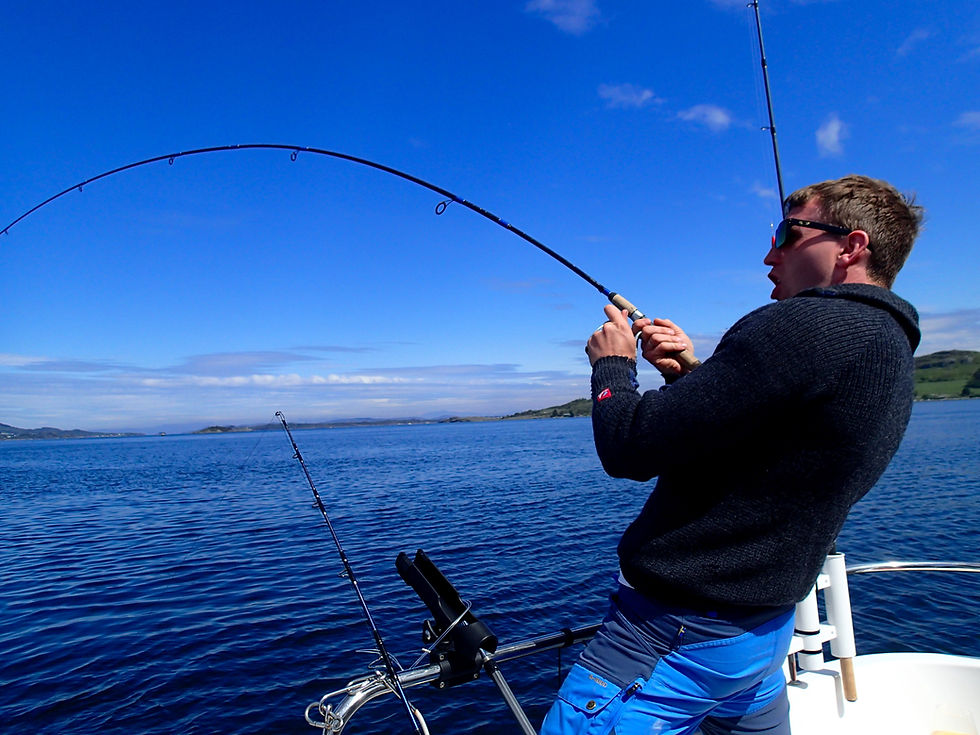
This is not just about reaching the bottom once, but about maintaining that connection continuously. Drift, current, and boat position all influence how your bait moves. Even a small change in angle or speed can lift your bait away from the bottom without you noticing. Staying aware of this, and making small adjustments to keep consistent contact, is what separates active fishing from passive waiting.
In practice, this means constantly feeling for the bottom, re-adjusting when needed, and keeping a clear sense of where your bait is in relation to the seabed. Once this becomes natural, the fishing becomes far more controlled, and results become much more predictable.
Adjusting Continuously Instead of Fishing the Same Way
Another key difference between inconsistent and effective fjord fishing is the ability to adjust continuously. Many people approach fishing as something static. They find a spot, drop the line, and repeat the same setup and movement without making changes. When nothing happens, it often feels like bad luck.

In reality, conditions in the fjord are constantly shifting. Wind direction, current strength, drift speed, and light conditions all influence where fish position themselves and how they respond. These changes are not always obvious from the surface, but they affect the fishing more than most people expect.
What makes the biggest difference is how you respond to these changes. Small adjustments in depth, weight, or position can be enough to move from an inactive area into a zone where fish are actually feeding. This often happens within very short distances.
In practice, this means paying attention, making small corrections, and staying flexible throughout the session rather than repeating the same approach. The more responsive you are to what is happening, the more controlled and consistent the fishing becomes.
Understanding Before Acting
Another key reason why most people don’t catch fish in the Stavanger fjords is that they react without first understanding what is happening below. One of the biggest differences between inconsistent and consistent fishing is the ability to interpret the situation before making changes.

Rather than reacting randomly, experienced anglers observe first. They pay attention to depth, structure, and the signals coming through the line before adjusting anything. This creates a more deliberate approach, where each change has a clear purpose.
In practice, this often means slowing down slightly and allowing the information to build. Small details such as how the bottom feels, how the drift behaves, or how the bait moves can reveal far more than constant adjustments made without direction.
Modern sonar systems can support this process by making the underwater environment visible. They show depth clearly, reveal structure, and often indicate where fish are holding in relation to the seabed.
On my trips, this is something guests can follow directly. The sonar view is shared on an iPad mounted near where you fish, making it easier to connect what you see on the screen with what you feel through the rod.
This combination of visual and physical feedback helps create a much clearer understanding of what is happening, and makes it easier to make the right adjustments at the right time.
Why This Becomes Easier Over Time
All of these elements are relatively simple on their own, but combining them in a natural and consistent way takes time. Recognizing structure, adjusting depth, and maintaining contact with the bottom are not complicated skills, but they depend on attention and repetition.

In the beginning, it can feel like there are many variables to keep track of. Over time, the patterns start to become clearer, and the fishing feels more controlled and predictable.
This is also where guided fishing makes a noticeable difference. Instead of trying to interpret everything on your own, you are guided through the process step by step. Small adjustments are made continuously, often before you would think to make them yourself. This creates a much clearer understanding of what is happening below the surface, and helps turn uncertainty into something more structured and manageable.
If you want to see how this works in practice, you can read more here:
Or explore the different options available:
A More Realistic Way to Approach Fjord Fishing
Fishing in Stavanger is not about maximizing numbers in the shortest possible time. It is about understanding where you are, how the environment works, and how small adjustments influence the outcome.
When you approach it this way, the experience naturally changes. The fishing becomes more engaging, more consistent, and more connected to the surroundings. You are no longer just waiting for something to happen, but actively taking part in the process. Small signals start to make sense, patterns become easier to recognize, and decisions feel more deliberate.
Over time, this creates a different kind of experience. One that is not only about catching fish, but about understanding what you are doing and why it works. That is where fjord fishing becomes both more effective and more meaningful.
Frequently Asked Questions About Fishing in Stavanger
Fjord fishing in Stavanger often looks simple from the outside, but there are several details that influence how the fishing actually works. These are some of the most common questions I receive from guests.
Why do many people struggle to catch fish in the Stavanger fjords?
Most people struggle because the fjord environment is more structured than it appears. Fish are not spread evenly, and they are rarely feeding randomly. Small differences in depth, bottom structure, and how the bait moves through the water often determine the outcome. Without noticing these details, it is easy to spend time fishing just outside the areas where fish are actually holding.
What depth should you fish in the Stavanger fjords?
There is no single correct depth, as it depends on species, conditions, and time of day. However, fish are usually concentrated within relatively narrow depth ranges. Being just a few meters above or below that zone can be enough to miss them completely. This is why adjusting depth continuously is one of the most important parts of fjord fishing.
Do you need heavy fishing gear for fjord fishing in Stavanger?
No, heavy offshore gear is usually not necessary. In sheltered fjord environments, lighter and more sensitive setups often give better results. They make it easier to feel the bottom and detect small changes, which is essential for staying connected to what is happening below the surface.
How important is bottom contact when fjord fishing?
Maintaining contact with the bottom is one of the key factors in fjord fishing. Many species feed close to the seabed, and losing contact with that zone significantly reduces the chances of getting bites. Continuous feedback from the bottom allows you to adjust and stay within the most productive area.
Is fjord fishing in Stavanger suitable for beginners?
Yes, fjord fishing is well suited for beginners, especially in a guided setting. The waters are relatively sheltered, and with the right guidance it becomes much easier to understand how depth, structure, and movement influence the fishing. Many guests have little or no previous experience and still get a clear and engaging introduction.
Can you see fish on sonar during fjord fishing?
Modern sonar systems can show depth and bottom structure very clearly, and often indicate fish activity. While you do not always see your exact bait, you can usually identify where fish are holding and adjust accordingly. When combined with what you feel through the rod, this creates a much better understanding of what is happening below.
Is fjord fishing in Stavanger about catching as many fish as possible?
Fjord fishing in Stavanger is not primarily about maximizing numbers. It is about understanding the environment, staying connected to the process, and enjoying a calm and personal experience on the water. For many guests, this is what makes the experience both more meaningful and more memorable.
These are some of the most common questions, but they all point in the same direction.
Fjord fishing becomes much clearer once you understand how depth, structure, and movement work together. With that in mind, the next step is to look at how this plays out in practice.
A Calm, Personal Way to Experience Fishing in Stavanger Norway
Fishing in Stavanger is not about doing everything perfectly. It is about understanding a little more each time you are out on the water.

Once you begin to notice how depth, structure, and movement come together, the experience naturally becomes more engaging and more rewarding. Not because it becomes easier, but because it starts to make sense.
For many guests, this shift is what makes the biggest difference. What begins as uncertainty quickly turns into curiosity, and eventually into a much clearer understanding of what is happening below the surface.
If you would like to experience this in a more guided and structured way, you can read more about what a typical day on the fjord looks like in my guide to what to expect on a private fjord fishing tour in Stavanger.
You can also explore the different private fjord fishing tours in Stavanger to find an option that fits your time and preferences.
Calm. Personal. Real

Comments